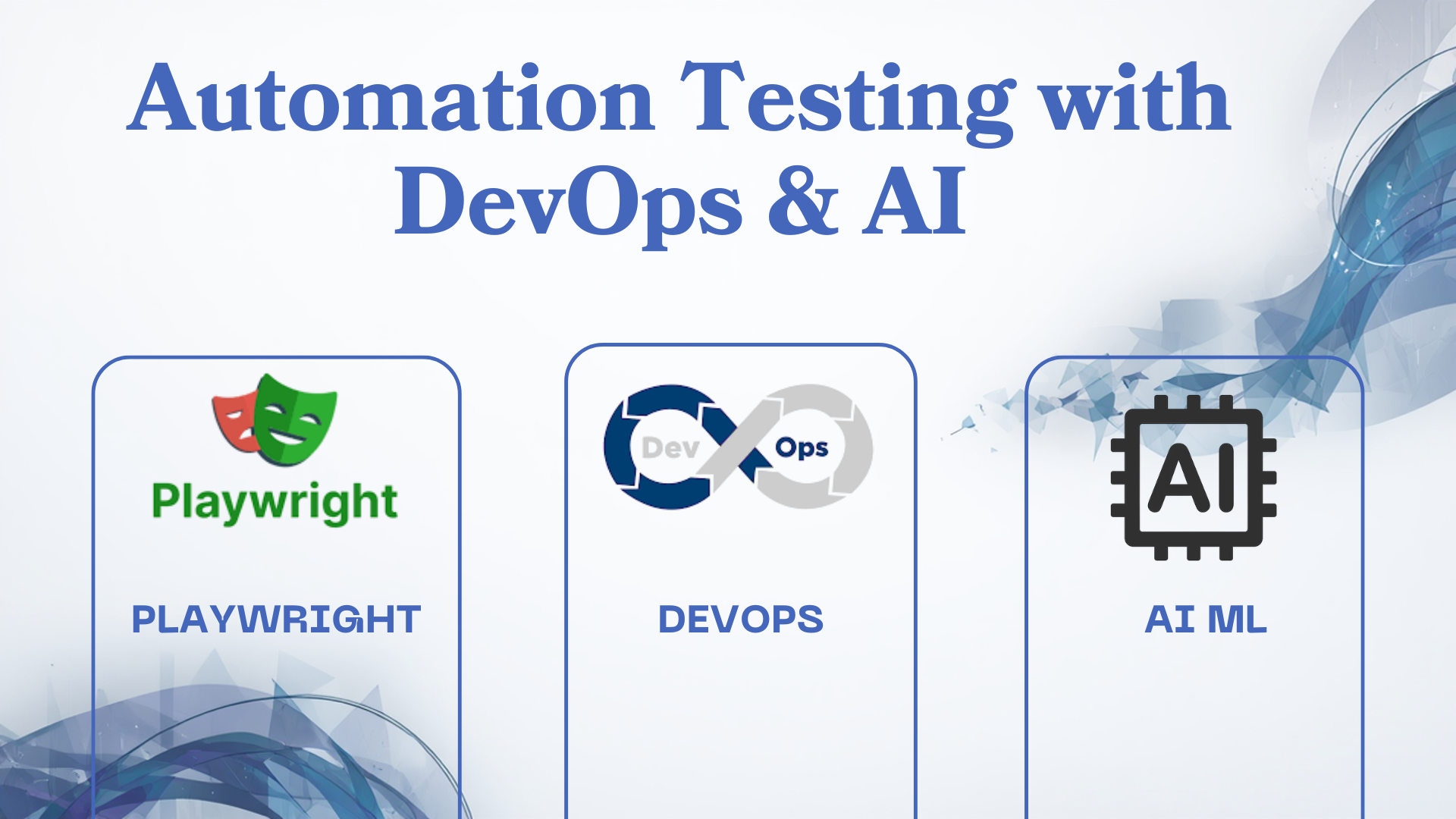
Learn Latest Playwright Testing on job training & get placed as a Automation Tester
CIIT's Playwright testing course equips participants with the skills to automate web application testing, design robust automation frameworks, and integrate testing into the full software development lifecycle
Get Your Dream IT Job Just in 4 Months
In 2026, Playwright has transitioned from a high-growth alternative to a dominant industry standard for modern web automation, increasingly favored over legacy tools for new enterprise projects.
Enquiry Now
Outcomes of Playwright Testing Training
-
Proficiency in Selenium Components
Understand and use the full Selenium suite, including Selenium IDE (for record-and-playback prototyping), Selenium WebDriver (for direct browser automation using programming languages like Java, Python, or C#), and Selenium Grid (for parallel test execution across different browsers and operating systems).
-
Test Script Development
Learn to write efficient, maintainable, and reusable test scripts to automate user interactions, such as clicking buttons, filling forms, and navigating pages.
-
Web Element Interaction
Master techniques for locating web elements on a page using various locators like ID, Name, CSS selectors, and XPath, and handle complex scenarios involving dynamic content, alerts, pop-ups, frames, and multiple windows.
-
Framework Implementation
Gain hands-on experience in building test automation frameworks from scratch, including Data-Driven, Keyword-Driven, and Hybrid frameworks, to manage test data and enhance code reusability.
-
Integration with Other Tools
Integrate Selenium with testing frameworks (TestNG, JUnit) for structured test management and reporting, build automation tools (Maven, Ant), and Continuous Integration/Continuous Delivery (CI/CD) pipelines (Jenkins, GitHub) for automated builds and testing.
-
Cross-Browser and Parallel Testing
Conduct cross-browser testing to ensure application compatibility across different browsers and use Selenium Grid to execute tests in parallel, significantly reducing test cycle time.
-
Enhanced Job Prospects
The demand for Selenium experts is high across various industries (e-commerce, finance, etc.), opening opportunities for roles such as Automation Tester, QA Engineer, Software Development Engineer in Test (SDET), and Test Automation Architect.
-
Practical Experience
Work on real-world case studies and projects to simulate actual testing scenarios, preparing for job responsibilities and building a strong project portfolio.
-
Career Advancement
Manual testers can transition into automation testing roles, and experienced professionals can progress to leadership positions like Test Lead or Automation Manager.
-
Problem-Solving and Analytical Skills
Develop strong analytical and debugging skills to identify issues, analyze test results, and provide detailed reports to stakeholders and development teams.
Weekdays (Mon-Fri) - 3 Months
Weekends (Sat & Sun) - 4 Months
Course Information
Batches Available: Weekdays/Weekends
Training Mode: Classroom & Online
Language: English, Hindi, Marathi

100% Money Back Guarantee
5-Day Money-Back Guarantee : Till date We have trained 10000+ candidates including under graduates,fresheres and working professionals with expert knowledge. All are satiesfied with our training quality. So we are giving guarantee to all those who want to join our institute that if you're disappointed for whatever reason, you'll get your 100% refund. We won't make you invoke any rules or conditions – if you're not satisfied within your first 5 days then we'll refund you without any excuse.
Our Alumini works at Top MNCs & Indian Companies. So Can You!
What are the Benefits of Playwright Testing Training?
-
Exceptional Career and Financial Value
Mandatory Skill Status: By late 2025 and into 2026, nearly 70% of automation testers are projected to transition to Playwright. LinkedIn and other job portals now frequently list Playwright as a "preferred" or "mandatory" skill for high-tier QA roles.
Superior Salary Potential: In 2026, professionals with Playwright expertise earn significantly more than those only skilled in traditional frameworks.
In India: Average annual salaries for those with Playwright skills reach ₹32.1 lakhs, with top earners exceeding ₹58.4 lakhs.
In the U.S.: The average annual salary for a Playwright Automation Engineer is approximately $116,607, with senior roles paying up to $165,000.
-
Rapid Career Progression
Training prepares you for advanced roles like SDET (Software Development Engineer in Test), Test Automation Architect, and DevOps Automation Engineer.
-
Elimination of Flaky Tests
Playwright’s auto-waiting mechanism and web-first assertions solve the #1 pain point in automation—unstable tests. It automatically waits for elements to be actionable before interacting, removing the need for manual "sleep" commands.
-
Extreme Execution Speed
Using a persistent WebSocket connection to communicate directly with browser engines, Playwright is 30–50% faster than Selenium, which relies on slower HTTP-based WebDriver protocols.
-
Native Parallelization
Playwright can run multiple tests simultaneously across CPU cores out of the box, reducing test suite runtimes from hours to minutes.
-
Advanced Modern Tooling
Learners gain access to powerful built-in tools like the Trace Viewer (for time-travel debugging), Codegen (recording actions to generate scripts), and native network interception for API mocking
-
Full-Stack Capability
A single Playwright API handles UI, API, and Mobile Web emulation (Android/iOS) across all major engines (Chromium, Firefox, WebKit), eliminating the need for separate tools like Appium or RestAssured for many projects.
-
Modern Web Support
It natively handles complex modern technologies that struggle in older tools, such as Shadow DOM, iframes, and Single-Page Applications (SPAs) built with React, Vue, or Angular.
-
CI/CD Alignment
Playwright integrates flawlessly with 2026 DevOps standards, including GitHub Actions, Azure DevOps, and Jenkins, enabling "Shift-Left" testing where bugs are caught earlier in the development cycle.
KEY Features that Makes Us Better and Best Campus For You
Expert Trainers
Training will be provided by Industry experts with extensive experience
State-of-the-Art Infrastructure
Modern facilities and tools for an engaging learning experience.
Comprehensive Curriculum
In-depth courses designed to meet current industry standards and trends.
Flexible Schedules
Options for weekday, weekend, and online batches to suit your convenience.
Personalized Attention
Small batch sizes for individualized mentoring and guidance.
100% Real time Project Training
Real-world actual industry projects and practical sessions to become experienced.
100% Placement Assistance
Dedicated support to help you secure your dream job.
Affordable Fees
Quality training at competitive prices with flexible payment options.
Lifetime Access to Learning Materials
Revisit course content anytime for continuous learning
Industry-Recognized Certifications
Globally accepted credentials to boost your career prospects.
Diverse Course Offerings
A wide range of programs in IT, business, design, and more.
Course Highlights
-
Programming Fundamentals (Language Specific)
-
Basics :
Variables, data types, operators, and control structures.
-
Asynchronous Programming :
Mastery of async/await, promises, and handling the asynchronous nature of web applications.
-
OOPs Concepts :
Classes, objects, inheritance, and encapsulation for framework design.
-
Basics :
-
Core Playwright Essentials
-
Introduction & Architecture :
Understanding Playwright's WebSocket-based architecture vs. legacy tools.
-
Environment Setup :
Installing Node.js, the Playwright library, and setting up IDEs like VS Code.
-
Browser Management :
Automating Chromium, Firefox, and WebKit (Safari) in headed and headless modes.
-
Locating Strategies :
Expert use of CSS, XPath, and Playwright-specific locators (getByRole, getByText).
-
Introduction & Architecture :
-
Advanced UI Automation
-
Interaction Handling :
Mastering clicks, typing (page.fill), dropdowns, checkboxes, and radio buttons.
-
Complex Scenarios :
Handling Shadow DOM, nested iFrames, multi-tab windows, and dynamic web tables.
-
Wait Mechanisms :
Understanding Playwright’s auto-waiting and custom wait strategies.
-
Media Actions :
Capturing screenshots, recording videos, and utilizing the Trace Viewer for deep-dive debugging.
-
Interaction Handling :
-
Framework Design & Best Practices
-
Page Object Model (POM) :
Implementing POM to create reusable, maintainable page classes.
-
Data-Driven Testing :
Parameterizing tests using external data sources like JSON, CSV, or Excel.
-
Test Runners :
Mastery of the built-in Playwright Test Runner, annotations (skip, only, fixme), and hooks (beforeEach, afterAll).
-
Parallel execution :
Configuring multi-worker execution to reduce total test runtime.
-
Page Object Model (POM) :
-
API, DevOps & 2026 Tech Integration
-
API Testing :
Sending GET/POST requests and chaining API responses with UI tests for end-to-end flows.
-
CI/CD Pipeline :
Integration with Jenkins, GitHub Actions, and Azure DevOps for continuous testing.
-
Dockerization :
Running tests in isolated containers for consistency across environments.
-
Visual Regression :
Implementing toHaveScreenshot() to detect unintended UI changes.
-
AI Integration :
Utilizing AI-powered tools like ZeroStep for natural language test generation and self-healing scripts
-
API Testing :
Who can do?
In 2026, Selenium testing is accessible to a wide range of professionals, from beginners to experienced developers. While a technical background is beneficial, it is not a strict requirement for entry-level learning.
-
Manual Testers :
This is the most common group. Testers who want to transition from manual execution to automation to increase their efficiency and salary potential.
-
Fresh Graduates :
Students from B.Tech, B.Sc, MCA, or equivalent streams looking for their first role in the IT industry.
-
Software Developers :
Developers who want to expand into Quality Assurance (QA) or perform unit and integration testing on their own code.
-
Career Changers (Non-IT Professionals) :
Individuals from non-technical backgrounds can learn Selenium by starting with the Selenium IDE (which requires no coding) before moving on to basic programming for WebDriver.
-
Career Changers (Non-IT Professionals) :
Individuals from non-technical backgrounds can learn Selenium by starting with the Selenium IDE (which requires no coding) before moving on to basic programming for WebDriver.
Selenium Testing Career Path
In 2026, the Playwright career path is one of the fastest-growing trajectories in software engineering. Because Playwright is designed for modern web architectures (React, Vue, micro-frontends), it has become the standard for companies prioritizing speed and "Shift-Left" testing.
| Stage | Experience | Salary | Role | Key Focus & Skills |
|---|---|---|---|---|
| Junior Automation Engineer | 0–2 years | ₹4 LPA – ₹8 LPA | Focused on transitioning manual test cases into automated scripts | Basic JavaScript/TypeScript or Python, Playwright locators, handling basic UI interactions, and utilizing Codegen for script generation. |
| Automation Test Engineer / SDET | 2–5 years | ₹9 LPA – ₹18 LPA | Designing and maintaining robust automation suites. | Implementing Page Object Model (POM), API testing integration, network mocking/interception, and cross-browser strategy |
| Senior SDET / Automation Lead | 5–9 Years | ₹18 LPA – ₹30+ LPA | Building custom reporters, managing parallel execution on Docker/Kubernetes, and implementing Visual Regression Testing. | Building scalable test architectures from scratch, implementing parallel execution on Selenium Grid, and adopting AI-powered tools for self-healing scripts. |
| Principal QA Architect / Quality Director | 10+ years | ₹20 LPA to ₹30+ LPA | Strategic oversight of quality across the entire organization | Defining the "Quality Engineering" vision, selecting the tech stack, and integrating AI-driven testing agents. |
Our Success Lies In Our Learner's, Success Stories
Explore our student's experiences and discover how we've helped them achieve their goals through excellence and dedication.

Vaibhav Saykar
One off the best institutes then other training institutions and specially for those students who wants to start their career for IT. i hope everyone can join with us Ciit training institute, recently I have placed so special thanks to all CIIT TEAM always support, gaide and give 🙏 Read Complete Feedback
Saurabh Lonkar
Learning at CIIT has been a truly rewarding experience. Trainers are very good — knowledgeable, approachable, and always ready to help. Each topic is explained clearly, and special attention is given to doubt-solving, which really helps in building a strong foundation.
Read Complete Feedback
Ajay Wagh
I recently completed the .NET Full Stack Developer course at CIIT Training Institute, and it was an excellent experience! The course content was practical and well-organized, helping me build strong development skills and real-time project
Read Complete Feedback
Kalyani Dhavale
I’m truly grateful for your mentorship throughout my journey with Python Selenium automation. Your deep expertise, structured guidance, and hands-on approach made complex concepts easy to understand. You not only helped me strengthen my technical skills ...
Read Complete Feedback
Anil Kamble
I had enrolled in October 2024 .Net Full stack Web Development batch. It is really fantastic learning experience. Mocks interview, topic revison, conceptual and practical approach with one to one doubt solving of mentors are really admirable.
Read Complete Feedback
Sagar Vyavhare
I had an excellent experience at CIIT Training Institute. The .NET Full Stack Developer course with React was comprehensive and well-structured. Special thanks to Leena Ma'am and Yuvaraj Sir for their expert guidance and hands-on approach...
Read Complete Feedback
Lubna Patel
As a Full Stack Development student at CIIT Training Institute, I can confidently say they provide excellent training from basics to advanced levels. With hands-on projects and internship opportunities, it's a great place to start your career in top companies.
Read Complete Feedback
PRAJWAL DIVEKAR
CIIT Training Institute is a great place to learn and grow, especially for those who want to start from basic to advance . they focus on providing best quality knowledge on the courses you choose with hands-on on projects and internship opportunities that helps to build real-world skills
Read Complete Feedback
Shesh Kumar Dwivedi
CIIT Training Institute offers excellent training in .NET Full-Stack Development. The instructors are knowledgeable and have designed a curriculum that covers everything from the basics to advanced topics. The hands-on projects are great for building practical skills...
Read Complete Feedback